

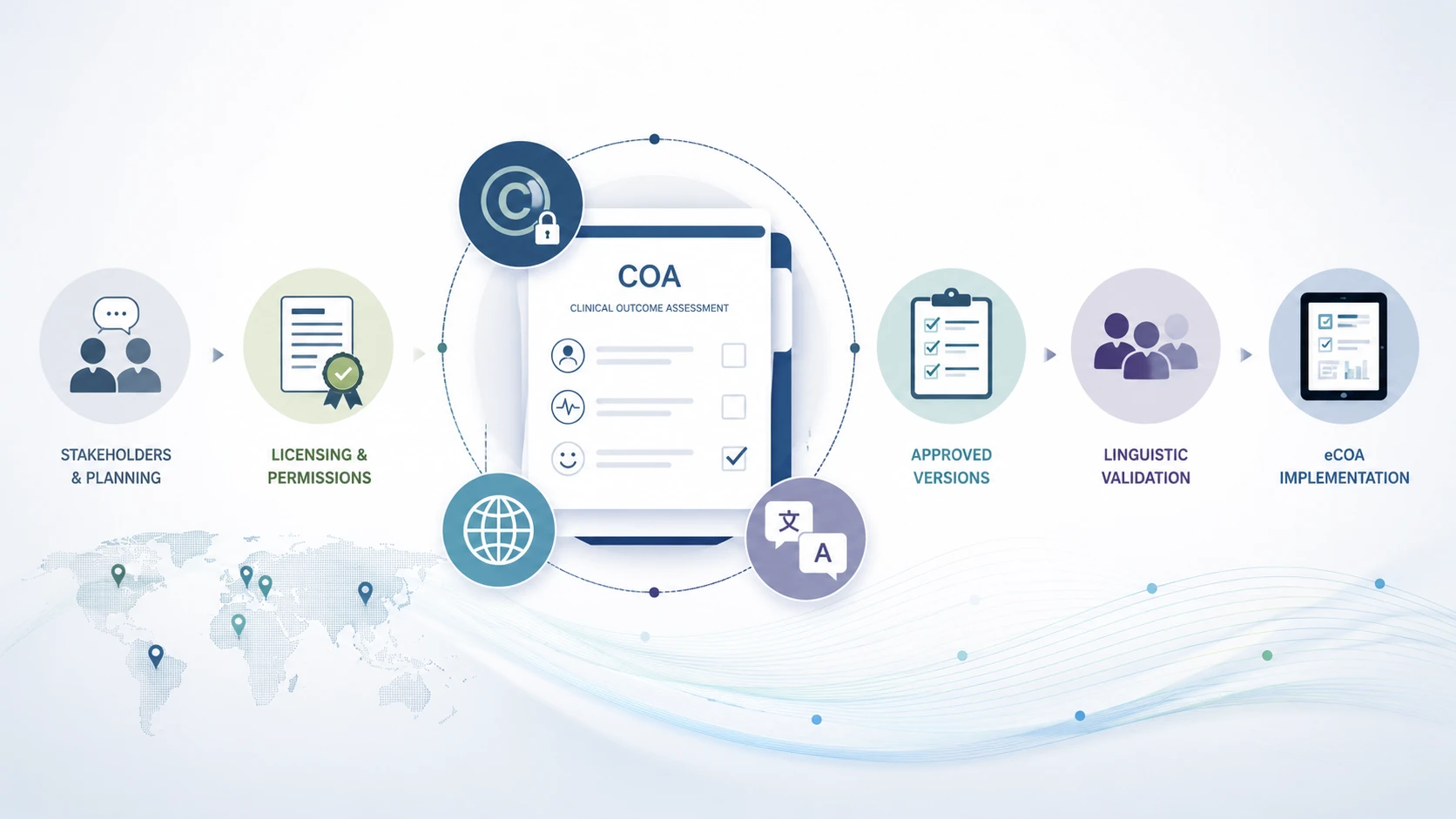
Clinical Outcome Assessments (COAs) are used throughout clinical development to capture how patients feel and function, how clinicians assess health outcomes, what observers report about observable signs, events or behaviors, and how participants perform defined tasks.
They include:
- Patient-Reported Outcome (PRO) measures;
- Clinician-Reported Outcome (ClinRO) measures;
- Observer-Reported Outcome (ObsRO) measures; and
- Performance Outcome (PerfO) measures.
Selecting an appropriate COA is only the beginning. Before an instrument can be used, translated, adapted or implemented electronically, the study team should confirm who controls it, which version is required and what permissions or conditions apply.
COA licensing and management connect these legal, scientific, linguistic and operational requirements across the study lifecycle.
Why COA Licensing Should be Considered Early
Licensing considerations should be addressed during early study and COA planning rather than only after the protocol and country scope have been finalised.
Early coordination helps the study team understand how the selected or proposed COAs may affect licensing, language and implementation requirements, including:
- the appropriate COA and exact version;
- the intended respondent and target population;
- the planned mode of administration;
- the countries and languages required;
- the copyright holder and authorised licensing party;
- existing validated translations;
- permissions required for new translations;
- permissions or requirements for electronic implementation;
- developer-review, training or approval requirements.
If licensing starts late, it may delay linguistic validation, eCOA configuration, regulatory submissions, site initiation or participant enrolment.
For more straightforward projects, allowing about four to six weeks for licensing may be reasonable. Projects involving uncertain ownership, specialised permissions or multiple instruments may take longer.
These estimates are indicative only. The licensing party, copyright holder, intended use and required agreement determine the actual timeline.
Instrument Selection and Licensing Are Connected but Different
Instrument selection asks whether a COA is appropriate for the study’s concepts of interest, population, context of use and intended endpoints.
Licensing asks whether the study has the necessary rights and approved materials to use that specific instrument in the intended way.
An instrument may appear appropriate scientifically but still present operational concerns, such as:
- restrictive licensing conditions;
- unavailable language versions;
- extensive developer-review requirements;
- restrictions on electronic implementation;
- mandatory rater training;
- lengthy approval timelines;
- unanticipated licensing and pass-through fees.
Considering scientific suitability and licensing feasibility together helps prevent later protocol changes and implementation delays.
The Developer May Not Be the Copyright Holder
The person or research group that developed a COA does not always control its licensing.
Rights may instead be held or administered by:
- an academic institution;
- an employer;
- a publisher;
- a research foundation;
- a commercial licensing organisation;
- another authorised distributor
The developer may remain an important scientific contact even when a separate organisation manages licensing and permission for use. Developer input may be required for questions about instrument selection, scoring, interpretation, modification, translation or electronic implementation.
Identifying the Correct COA Version
Instrument identification should extend beyond recording an acronym.
The same COA may exist in different:
- editions or release versions;
- modules or short forms;
- age-specific versions;
- patient- and caregiver-reported formats;
- regional or language variants;
- paper and electronic formats;
- modified or trial-specific versions;
- licensed and publicly accessible versions
Different versions may have different owners, licensing conditions, content, scoring rules or electronic use requirements.
Useful protocol information for confirming the intended version includes:
- the full instrument name;
- schedule of assessments and associated footnotes;
- bibliographic references;
- respondent type;
- patient age range;
- number of items;
- recall period;
- administration schedule;
- paper or electronic mode of administration
Is the COA Copyrighted or in the Public Domain?
Finding a COA online does not necessarily mean that it is free to use.
A publicly accessible copy may still be copyrighted, outdated, incomplete or posted without the owner’s permission. Conversely, an instrument developer may have formally made a particular version available for unrestricted use.
The status should therefore be confirmed through reliable evidence, such as:
- information published by the copyright holder;
- the original instrument publication;
- an authorised COA database;
- direct confirmation from the developer;
- confirmation from the copyright holder and licensing authority;
- formal terms governing the instrument’s use.
What May a COA License Cover?
The permitted scope varies by instrument and agreement. Depending on the project, the license may define:
- the study or clinical programme;
- countries and study sites;
- number of participants or administrations;
- paper and/or electronic use;
- authorised language versions;
- permission to produce new translations;
- permission to adapt or migrate the COA electronically;
- instrument-owner review requirements;
- distribution and reproduction rights;
- scoring materials and user manuals;
- publication or dissemination rights;
- fees and payment terms;
- the license period
A license for one study should not automatically be assumed to cover another study, even when the same sponsor, instrument or language versions are involved. The terms should be checked with the licensing party for every new intended use.
Existing and New Language Versions
The licensing assessment should establish which validated translations are already available and which must be developed.
Existing versions should be checked for:
- country and language variant;
- validation status;
- version alignment;
- permitted study use;
- certification and supporting documentation;
- compatibility with the intended administration mode
A version should not be recreated simply because a copy cannot be located internally. The copyright holder may already control an authorised translation that should be obtained through the appropriate licensing process.
Where a new translation is required, any applicable copyright holder or licensing requirements should first be established and the necessary permission obtained. These requirements may specify the linguistic validation methodology, use of designated providers, developer involvement, documentation and approval stages.
Depending on the required methodology and project scope, new Linguistic Validation may require approximately six to ten weeks or longer. Instrument complexity, reviewer availability, rare languages, clinician review and cognitive debriefing requirements may affect the schedule.
Electronic Use Requires Separate Attention
Permission to use a paper COA does not always include permission to implement it electronically.
The project team should confirm:
- whether electronic use is permitted;
- which source and language versions may be migrated;
- whether instrument-specific implementation guidance exists;
- which adaptations are allowed;
- whether the developer and copyright holder must review the electronic presentation;
- whether certification or approval is expected;
- whether separate fees apply
The sponsor’s selected eCOA provider, licensing party and linguistic team should work from the same authorised materials and requirements.
Migration should preserve the approved content and intended meaning of the instrument. Any proposed wording, layout or functionality change outside the authorised scope should be documented and referred to the appropriate stakeholder for approval.
COA Licensing Versus COA Management
Licensing secures the rights and authorised materials needed for defined use.
COA management continues after the agreement is signed. It helps ensure that:
- the correct versions are implemented;
- licensing terms are communicated to all stakeholders;
- translations follow the required methodology;
- eCOA implementation follows applicable copyright holder/developer requirements and approved instrument specifications;
- approvals and review records are retained;
- fees and milestones are tracked;
- scope changes are assessed;
- project documentation remains complete and traceable
This continuing coordination is particularly important in international studies involving several instruments, languages, vendors and modes of administration.
Common COA Licensing Risks
Beginning Too Late
Licensing delays can affect translation, linguistic validation, eCOA build, submissions and site-readiness milestones.
Using the Wrong Instrument Version
A similarly named, shortened, modified or outdated version may not match the protocol or approved endpoint strategy.
Assuming Online Availability Means Free Use
Public accessibility does not prove public-domain status or confirm permission for study use.
Overlooking Translation Availability
Existing validated translations may be missed, or the time required to develop new versions may not be included in the study plan.
Assuming Paper Rights Cover eCOA
Electronic implementation may require additional permission, guidance, review and fees.
Modifying Content Without Approval
Unauthorised changes may affect copyright conditions, conceptual integrity and acceptance of the instrument.
Fragmented Stakeholder Coordination
Clinical, legal, licensing, linguistic validation, eCOA and data management teams may work to different assumptions unless ownership and communication routes are clearly defined.
Planning Questions for Sponsors and CROs
Before beginning the licensing process, confirm:
- Which COAs are being considered, selected, or already specified in available study documentation
- What is the exact version and respondent type?
- What target population and age range will each instrument use?
- Which countries and languages are required?
- Are approved translations already available?
- Have the corresponding linguistic validation requirements been followed?
- Will the COA be administered on paper or electronically or both?
- Does the license cover the intended mode of administration?
- Are scoring manuals or rater training materials needed?
- What are the planned submission, site-initiation and first participant dates?
- Who will own the COA workstream and track its status?
How NN Translations Supports COA Licensing and Management
NN Translations works with clinical trial sponsors, CROs, COA licensing companies, copyright holders, linguistic validation consultants and eCOA providers to coordinate the licensing and language requirements surrounding COA implementation.
Our support can include:
- requirements intake and project scoping;
- coordination with specialist COA licensing partners;
- instrument, version, copyright holder, and existing translation research through our COA licensing partners;
- coordination of licensing requests, quotations, fees, agreements, and permissions through our COA licensing partners;
- tracking of licensing status, permissions, and approved materials in coordination with our COA licensing partners;
- translation availability and language gap assessment;
- assessment of existing translations and linguistic validation history against project requirements;
- identification of missing or additional linguistic validation and adaptation requirements;
- linguistic validation planning and coordination;
- eCOA migration and screenshot review coordination
Contractual terms are reviewed and agreed upon by the sponsor or its authorised legal representative(s) and the copyright holder.
Start Before Licensing Becomes the Critical Path
Early coordination helps connect the selected instrument with the intended patient population, protocol, language scope, mode of administration and study schedule before licensing, translation or implementation issues threaten critical milestones.
Important Note
This guide provides general information about COA licensing and management and is not intended as legal, regulatory or instrument-specific advice. Licensing, copyright, translation and implementation requirements vary by instrument, copyright holder, licensing party, study and intended use. Project-specific requirements should always be confirmed with the relevant stakeholders.
Explore Our COA Licensing and Management Services →
Explore Our Resources
- COA Licensing Resources →
- Linguistic Validation Resources →
- eCOA Resources →
- Webinars →
Explore Insights Hub →
Explore Case Studies →
Discuss Your COA Licensing Requirements
Contact us at any stage of study planning. Share your available study information, such as the intended population, proposed COAs or endpoints, target countries and languages, planned mode of administration, and expected study timeline.
Email info@nntranslations.com