

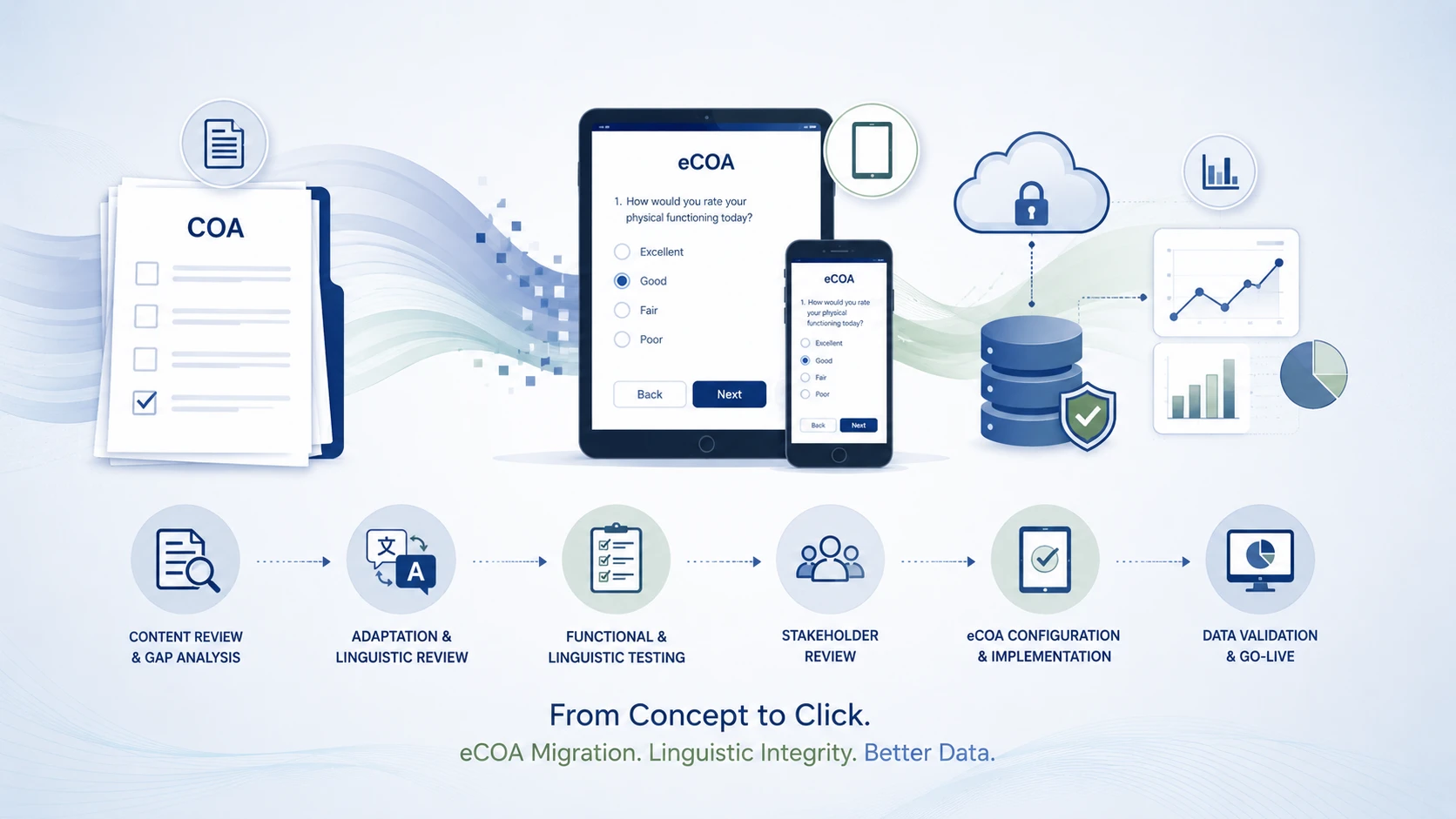
Migrating a validated Clinical Outcome Assessment (COA) to an electronic platform is not simply a technical conversion. It requires coordinated decisions across licensing, Linguistic Validation, electronic implementation and quality review.
Clinical trial sponsors, CROs, instrument developers, copyright holder, COA licensing companies, linguistic specialists and eCOA providers should work together to help ensure that the electronic presentation preserves the conceptual equivalence, intended meaning and usability of the validated instrument while supporting the comparability of data collected across languages and modes of administration.
This article explains the difference between eCOA migration and screenshot review, the responsibilities of the stakeholders involved and the controls that support conceptual equivalence and data comparability across languages and modes of administration.
What Is eCOA Migration?
An electronic Clinical Outcome Assessment (eCOA) is an electronically administered version of a Patient-Reported Outcome (PRO), Clinician-Reported Outcome (ClinRO), Observer-Reported Outcome (ObsRO) or Performance-Outcome (PerfO) measure.
During migration, the approved content is transferred from a paper-based or other source format to an electronic platform. This may require authorised adaptations to instructions, item presentation, response options, navigation elements, dynamic fields or formatting so that the instrument can function appropriately on the intended device.
These adaptations must be controlled carefully. The objective is not to improve or rewrite the validated content, but to preserve its meaning while accommodating the requirements of electronic administration.
Why Does Equivalence Matter?
A change in mode of administration should not unintentionally change how patients, participants, observers or clinicians understand and respond to an assessment.
Differences in wording, formatting, screen structure, response-option presentation or navigation may influence how the instrument is completed. If these differences affect interpretation or response behaviour, they may also affect the comparability of the data collected.
A controlled migration process therefore helps:
- preserve conceptual equivalence between validated and electronic versions;
- protect the content and intended use of the instrument;
- maintain consistency across languages and modes of administration;
- identify linguistic and display issues before study deployment; and
- support the collection of reliable and comparable clinical outcome data.
The evidence required to support equivalence will depend on the nature and extent of the changes introduced during implementation. Relevant considerations are addressed in recommendations from the Critical Path Institute’s eCOA Consortium and ISPOR guidance concerning measurement equivalence.
Who Is Responsible for eCOA Implementation?
An eCOA project normally involves several organisations with different responsibilities.
Clinical Trial Sponsor or CRO
The sponsor or CRO confirms the study requirements, selected instruments, target populations, countries, languages, modes of administration, intended devices and implementation schedule.
Instrument Developer, Copyright Holder or Licensing Authority
The instrument developer, copyright holder or licensing authority may define requirements for the electronic use and implementation of the COA. Depending on the instrument, these may include licensing conditions, approved source and language versions, authorised adaptations, implementation guidance and approval requirements. Where applicable, required approvals should be obtained before the electronic instrument is deployed.
eCOA Provider
The eCOA provider configures and programs the electronic instrument, generates the screens and manages the platform’s technical development, testing, system validation and production deployment.
Linguistic Validation and Migration Team
The linguistic team reviews the migrated content against the approved source and validated language versions. It also performs in-country screenshot review and coordinates the resolution of linguistic queries.
Responsibilities and approval routes should be agreed during project initiation to prevent duplicated work, implementation gaps and late-stage changes.
Migration Linguistic Review and Screenshot Review Are Different Stages
Although closely connected, migration linguistic review and screenshot review serve different purposes.
Migration Linguistic Review
Migration linguistic review examines the content transferred into the implementation or migration file before or during platform configuration.
The review may cover:
- instrument titles, instructions and items;
- response options and response scales;
- item numbering and screen order;
- approved electronic wording adaptations;
- terminology consistency;
- formatting tags;
- dynamic fields and placeholders;
- consistency between related items and branches
Every segment should be checked against the approved language version (legacy translation) rather than relying solely on content retrieved from a translation memory or an earlier working file. If an unexpected discrepancy is found, it should be corrected. The reviewer also verifies that the correct validated language version has been transferred accurately and that any electronic adaptations correspond to the approved mapping sheet or eCOA adaptation report or instrument-specific implementation guidance. The reviewer should follow the approved legacy version and the applicable mapping sheet. Any potential change outside the authorised scope should be documented and escalated through the agreed query and approval process.
Linguistic Screenshot Review
Screenshot review takes place after the eCOA provider has configured the instrument and generated the screens that will be presented to users.
This stage verifies the accuracy of the displayed language and its presentation within the electronic environment. It may identify problems that are not visible in the migration file, including truncated text, inappropriate line breaks, overlapping content, missing characters, inconsistent formatting or insufficient space within navigation buttons.
The review commonly considers:
- missing, incorrect, duplicated or misplaced text;
- spelling, punctuation and character display;
- line breaks, spacing and text truncation;
- response-option presentation;
- headings, footers and navigation labels;
- meaningful bold, italic, underlined, superscript or subscript formatting;
- consistency across related screens;
- the positioning and linguistic behaviour of dynamic content.
Dynamic fields require particular attention in languages where an inserted term may affect grammatical gender, number, case or agreement. The surrounding wording should remain grammatically correct when the variable content is displayed.
Migration linguistic review should generally precede screenshot review. Screenshot review should not be treated as a substitute for controlling the content before it is configured on the platform.
What Should Be Confirmed Before Migration Begins?
Early confirmation of the project inputs can prevent delays and unnecessary review cycles. The project team should establish:
- the correct source instrument and version;
- the approved language versions and variants;
- licensing permission for electronic use;
- the intended target population;
- the planned mode of administration;
- the supported devices and screen sizes;
- the selected eCOA platform and provider;
- developer-specific / copyright-holder-specific implementation requirements;
- applicable mapping or adaptation guidance;
- the query and approval process;
- responsibility for final approval.
Version control is essential. The electronic content should be reviewed against the authorised source and validated target-language versions, not an unverified translation memory entry, draft file or outdated instrument version.
Managing Platform Limitations
Electronic platforms may not always reproduce the source format exactly. Potential limitations may relate to screen size, scrolling, response-option layout, navigation, conditional logic or character display.
Where a platform limitation affects the approved content or presentation, the issue should be documented and assessed for its linguistic and conceptual impact. The project team should identify the closest suitable alternative and obtain developer/copyright holder approval where required before implementing the adaptation.
Technical convenience alone should not determine how a validated instrument is modified.
Managing Queries and Corrections
Queries should be documented in a structured migration or screenshot review report. Each comment should identify:
- the language and screen concerned;
- the issue identified;
- the approved reference content;
- the proposed correction;
- the reason for the correction; and
- the party responsible for implementation or approval.
The eCOA provider implements the agreed corrections and supplies revised screens where necessary. The linguistic reviewer then verifies that the changes have been implemented correctly and have not introduced additional issues.
Questions affecting instrument content, conditional logic, developer requirements or the intended interpretation of an item may need to be escalated to the instrument developer, copyright holder or licensing authority.
What May Be Included in an eCOA Implementation Scope?
Across the different stakeholders involved, an eCOA implementation scope may include:
- project management and stakeholder coordination;
- eCOA build and programming;
- migration linguistic review;
- translation or linguistic validation, where required;
- screenshot review;
- cognitive debriefing, where justified;
- instrument developer and/or copyright holder review;
- proofreading and quality control;
- User Acceptance Testing;
- final production deployment;
- delivery of the applicable language files and review documentation
The quotation should clearly identify the languages, countries, instruments and devices covered, together with assumptions, exclusions, pass-through costs, review rounds, stakeholder responsibilities, payment milestones and key deliverables.
An Illustrative eCOA Workflow
A high-level workflow may include:
- Licensing and requirements confirmation
Confirm the authorised instrument, language versions, devices and implementation requirements. - Source and version control
Establish the approved source of truth for every language. - Migration linguistic review
Verify the transferred content and authorised electronic adaptations. - Platform configuration
The eCOA provider builds and programs the electronic instrument. - Linguistic screenshot review
In-country specialists review the instrument as displayed electronically. - Query resolution and correction verification
Agreed corrections are implemented, documented and rechecked. - UAT, approval and deployment
The responsible stakeholders complete the applicable technical testing and final approvals before production release.
Project schedules vary based on instrument complexity, language scope, licensing conditions, platform requirements, and developer availability. Early planning is always essential.
What Documentation May Be Produced?
Depending on the agreed linguistic scope, project documentation may include:
- a completed migration review file;
- a mapping sheet or eCOA adaptation report;
- a screenshot review report;
- a query and resolution log;
- annotated screenshots;
- confirmation/approval that agreed corrections have been verified;
- a certificate, etc.
How NN Translations Supports eCOA Projects
NN Translations supports clinical trial sponsors, CROs, COA licensing companies and eCOA providers with the coordination and linguistic review required for electronic COA implementation. We connect licensing requirements, approved language versions, instrument owner requirements and the eCOA provider’s implementation workflow.
We can provide:
- coordination of licensing, instrument owner and language requirements;
- confirmation and control of approved source and target language materials;
- eCOA migration linguistic review;
- in-country screenshot review;
- linguistic query and stakeholder feedback management;
- coordination with instrument owners, clinical trial teams and eCOA providers;
- verification of implemented linguistic corrections;
- preparation of agreed linguistic review documentation.
We work with the clinical trial sponsor’s selected eCOA provider or, where required, coordinate implementation through our trusted network of experienced eCOA partners. The eCOA provider remains responsible for platform configuration, technical implementation, system validation, UAT support and production deployment.
Plan Your eCOA Migration Early
Electronic implementation requirements should ideally be considered during early study and COA planning and addressed as part of the COA licensing process where applicable. Confirming the instrument, licensing conditions, target populations, languages, devices and eCOA provider early can reduce avoidable queries, duplicated work and implementation delays.
Explore Our eCOA Migration Services →
Explore Our Resources
- Linguistic Validation Resources →
- COA Licensing Resources →
- eCOA Resources →
- Webinars →
Explore Insights Hub →
Explore Case Studies →
Discuss Your eCOA Project
Contact us to discuss your instrument, target languages, approved versions, selected eCOA platform, planned implementation timeline and more.
Email info@nntranslations.com