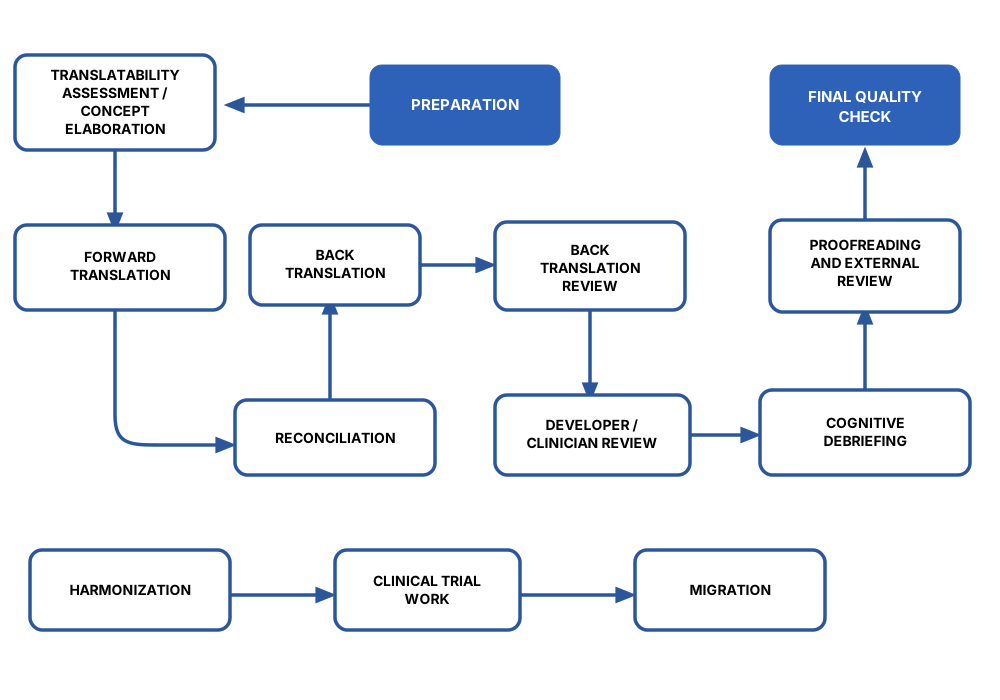
When it comes to medical device translations, the workflow you choose is not just an operational detail – it directly impacts compliance, quality and, ultimately, patient safety.
For manufacturers working with Instructions for Use (IFUs), Summaries of Safety and Clinical Performance (SSCPs), Declarations of Conformity and other regulatory documentation, translation must be structured, traceable and audit-ready at every stage.
At NN Translations, our workflows are built on a detailed Standard Operating Procedure (SOP) specifically designed for medical device content. This allows us to combine regulatory compliance with operational flexibility, so each project follows the right path based on its complexity and risk level.
Key takeaways
Your translation workflow directly affects compliance, quality and patient safety – it is not just an operational detail.
Before choosing a workflow, check whether the source IFU is ready for translation. IFU Content Optimisation resolves ambiguity, inconsistent terminology and structural gaps first.
Translation + Review suits standard-risk content and tight timelines; Translation + Review + Proofreading suits high-risk, patient-facing and regulatory content.
A pilot sample of approximately 2,000 words helps align expectations before the process is scaled to the full document set.
Structured preparation, QA checklists and optional spot checks make quality measurable and auditable.
In this article
The Step Most Companies Miss: IFU Content Optimisation
Before selecting a translation workflow, there is a more fundamental question:
Is your source content ready for translation?
In our experience, many IFUs are not. Even the most robust translation process cannot fully compensate for:
unclear or ambiguous wording;
inconsistent terminology;
poor structure;
gaps in regulatory alignment.
This is why we introduce a critical step before translation begins: IFU Content Optimisation.
Our IFU Content Optimisation Workflow
This structured process ensures that your content is clear, consistent and compliant before it is translated into multiple languages. Click each step to see what it involves.
1
Revision by a Target-Language Native Linguist
The source content is reviewed from a translation perspective.
1
Revision by a Target-Language Native Linguist
The source content is reviewed from a translation perspective.
A linguist reviews the source content from a translation perspective, identifying:
ambiguities;
additions and omissions;
inconsistencies;
terminology issues;
structural problems.
2
Monolingual Review by a Native Linguist
The text is refined for clarity, flow and comprehension.
2
Monolingual Review by a Native Linguist
The text is refined for clarity, flow and comprehension.
A native-language expert refines the text for:
clarity and readability;
natural flow;
user comprehension.
3
Regulatory Affairs (RA) Expert Review
A structured, compliance-focused review with annotated deliverables.
3
Regulatory Affairs (RA) Expert Review
A structured, compliance-focused review with annotated deliverables.
A Regulatory Affairs expert performs a structured compliance-focused review.
Scope includes
document organisation;
language clarity and readability;
terminology consistency;
regulatory wording (MDR-style);
safety-related wording;
identification of potential gaps with EU regulatory requirements;
identification of safety-related concerns.
Deliverables include
an annotated Word document;
inline comments and tracked changes;
a recommended table of contents to improve document structure;
a regulatory summary outlining the main findings, possible gaps and any critical points to consider from both a regulatory and usability perspective.
This step ensures the IFU is aligned with regulatory expectations and ready for submission.
4
Bilingual Integration of Changes
All feedback is consolidated into one consistent version.
4
Bilingual Integration of Changes
All feedback is consolidated into one consistent version.
All feedback is consolidated and integrated, ensuring:
consistency across the document;
terminology alignment;
translation readiness.
5
Client Review and Approval
The optimised IFU is approved before translation begins.
5
Client Review and Approval
The optimised IFU is approved before translation begins.
The optimised IFU is reviewed and approved by you before translation begins, so every language version starts from the same agreed source.
A Practical First Step: Start with a Sample
~2,000
word pilot sample
To ensure full alignment and demonstrate the depth of our approach, we typically begin with a pilot sample of approximately 2,000 words.
The sample allows you to
evaluate the quality and depth of the linguistic and regulatory review;
see how clarity, readability and structure are improved;
assess the level of detail in annotations, comments and recommendations;
align expectations before scaling the process to the full document set.
Based on the sample, we can
expand the scope of the Regulatory Affairs review to cover additional aspects, if needed;
refine the approach based on your internal feedback;
apply the agreed methodology consistently across the remaining content.
This step ensures a smoother process overall, making it easier to standardise improvements and implement changes efficiently across all documents.
Why This Step Changes Everything
By optimising content upfront, you achieve:
Regulatory alignment
Improved alignment with regulatory expectations (e.g. MDR-style wording)
Early identification of potential compliance gaps before submission
Reduced risk of delays during regulatory review or market approval
Greater confidence during audits and inspections
Clarity and safety
Clearer and more structured document organisation
Stronger consistency in safety-related wording across all sections
Improved readability and user comprehension
Reduced risk of misinterpretation
Efficiency
Fewer revision cycles and less back-and-forth with stakeholders
Fewer queries during translation
Higher consistency across languages
Faster and more efficient workflows
In short: better input = better output and significantly lower regulatory risk.
The Two Core Translation Workflows
Once the source content is fully optimised, we apply the appropriate medical and regulatory translation workflow. Our SOP defines two main workflows, aligned with ISO 17100 and ISO 9001.
Workflow 1 · One-step review
Translation + Review
This workflow includes
translation by a native medical translator;
independent revision by a second linguist;
terminology and consistency checks;
QA checks within the CAT tool.
The reviser ensures that the translation is accurate, consistent and aligned with regulatory expectations.
Ideal when
timelines are tight;
the content is standard-risk;
efficiency is a priority.
It provides a strong, compliant foundation while keeping turnaround times under control.
Workflow 2 · Two-step review
Translation + Review + Proofreading
This workflow includes
translation;
revision;
proofreading (independent final review).
For higher-risk content, a second independent review step is added. The proofreader performs a final validation of consistency across the document, terminology adherence, formatting and completeness, and potential omissions or ambiguities.
Recommended for
high-risk or patient-facing IFUs;
regulatory submissions;
content subject to audits;
high-visibility documentation.
It adds an extra layer of quality assurance and significantly reduces risk.
What Happens Behind the Scenes
A strong workflow is not just about adding steps. It is about structuring each phase properly.
01
Qualification and preparation
Client requirements are clarified via a pre-project questionnaire, language variants are confirmed, glossaries, translation memories and style guides are prepared or updated, and a project-specific brief is shared with all linguists.
02
Structured translation
Linguists work in CAT tools with validated resources, queries are documented and resolved, and terminology is applied consistently. Larger projects are divided into batches so that revision can begin early.
03
Controlled review
Reviewers and proofreaders apply QA checks, follow medical device-specific evaluation criteria and complete structured quality checklists.
04
Optional spot check
For one-step review workflows, a final bilingual spot check of key segments, terminology and formatting adds an extra layer of confidence before delivery.
Why preparation is critical
Without a proper preparation phase, even the best translators cannot ensure consistency across languages and documents. Structured checklists make quality not subjective, but measurable and auditable.
Further reading: Medical Device Translation Workflow: Quality, Compliance & Long-Term Value
Optional but strategic: spot checks
For one-step review workflows, we often recommend a final spot check. This includes:
bilingual sampling of key segments;
terminology verification;
formatting and consistency checks.
While optional, this step adds an extra layer of confidence before delivery, especially when proofreading is not included.
Flexibility for real-world needs
While the two core workflows cover most use cases, our SOP allows for additional adaptations depending on project requirements. These may include:
in-country review by local affiliates;
clinician review for medical validation;
linguistic reconciliation after external feedback;
structured handling of document updates.
This ensures that each project is not only compliant but also tailored to real-world regulatory and operational needs.
Choosing the Right Approach
Selecting the right workflow depends on your priorities. Choose the description that best matches your project:
Recommended workflow
Translation + Review
Choose this workflow if:
the content is standard-risk;
speed and efficiency are key;
you have internal validation processes.
Consider adding a final spot check for extra confidence. See what this workflow includes.
Recommended workflow
Translation + Review + Proofreading
Choose this workflow if:
the content is high-risk or patient-facing;
it will undergo regulatory scrutiny;
you need maximum assurance.
Start here
IFU Content Optimisation
Consider optimising the source content first if:
your source content is complex or inconsistent;
you want to reduce risk before translation;
you aim for long-term consistency across markets;
your IFUs are patient-facing and require high readability and clarity;
you are preparing for regulatory submission or expect regulatory scrutiny;
you want to align your content with MDR-style regulatory wording;
you have received queries, inconsistencies or rework in previous translation projects;
your internal teams (RA, medical, marketing) provide conflicting feedback;
you want to minimise revision cycles and speed up time-to-market;
you are expanding into multiple languages and need a scalable, consistent source;
you want to identify potential compliance or safety gaps early in the process.
Final Thought: Workflow Is Your Risk Management Strategy
In medical device translation, quality is not something you “check at the end”. It is built into the workflow, from the first review of the source content to the final linguistic check.
A well-designed workflow ensures that:
every step is controlled and documented;
every stakeholder knows their role;
every deliverable is consistent, compliant and audit-ready.
Ultimately, the right workflow protects not just your documentation but your product, your users and your reputation.
Frequently Asked Questions
What is IFU Content Optimisation?
It is a structured review of the source IFU before translation: a target-language native linguist revision, a monolingual review, a Regulatory Affairs expert review, bilingual integration of changes and client approval. The aim is clear, consistent and compliant source content before it is translated into multiple languages.
Which translation workflow should I choose?
Translation + Review suits standard-risk content, tight timelines and projects where you have internal validation processes. Translation + Review + Proofreading is recommended for high-risk or patient-facing IFUs, regulatory submissions, content subject to audits and high-visibility documentation.
Why start with a pilot sample?
A pilot sample of approximately 2,000 words lets you evaluate the depth of the linguistic and regulatory review and align expectations before the agreed methodology is applied consistently to the full document set.
What is a spot check?
An optional final check for one-step review workflows, including bilingual sampling of key segments, terminology verification and formatting and consistency checks. It adds confidence before delivery, especially when proofreading is not included.
Which standards are the workflows aligned with?
Our SOP defines the two core translation workflows in alignment with ISO 17100 and ISO 9001.
Struggling with content optimisation or translation workflows?
Tell us about your IFUs, target languages and timelines, and we will recommend the right workflow for your project. You can also reach us at info@nntranslations.com.