Cognitive Debriefing (CD), sometimes referred to as cognitive interviewing, is an important stage of Linguistic Validation when translated Clinical Outcome Assessments (COAs) need to be evaluated with representatives of the intended target population.
For clients planning or managing multilingual Linguistic Validation projects, Cognitive Debriefing provides important insight into whether translated COA content is understood as intended by the target population before the instrument is finalised.
This guide explains when Cognitive Debriefing may be required, who should participate, how participants are recruited, what happens during the interviews and how participant feedback is evaluated before the translated COA is finalised.
Key takeaways
- Cognitive Debriefing evaluates whether the intended population understands translated COA content as intended – not whether participants “like” the wording.
- It is not required for every COA or project. The need depends on the instrument, intended respondents, target population, previous validation work and the developer or copyright-holder methodology.
- Participants should represent the intended respondents, and recruitment feasibility should be assessed early – especially for rare diseases, narrow eligibility criteria and multi-country studies.
- Participant feedback does not automatically change the translation. The Linguistic Validation Consultant evaluates it against the source concept to preserve conceptual equivalence.
- Clinician Review and Cognitive Debriefing provide complementary clinical and patient perspectives, and the findings are documented as part of the Linguistic Validation record.
What Is Cognitive Debriefing?
Cognitive Debriefing is a structured process used to evaluate how representatives of the intended target population understand and interpret translated COA content.
Participants review the translated instrument and are interviewed about their understanding of individual items, instructions, response options and other relevant content.
The purpose is not simply to ask whether participants “like” the translation. It is to assess whether the wording is clear, understandable and interpreted consistently with the concepts intended by the source instrument.
Cognitive Debriefing can therefore identify issues that may not be apparent during translation and linguistic review alone.
Why Is Cognitive Debriefing Important?
A translation can be linguistically accurate and still be difficult for the intended population to understand.
Patients may interpret particular words differently from translators or clinicians. Healthcare terminology that appears clear to a specialist may be unfamiliar to patients. An expression may also be grammatically correct but sound unnatural or convey an unintended meaning in everyday language.
Cognitive Debriefing provides an opportunity to evaluate the translated COA with people who reflect the population for whom it is intended.
The findings can help determine whether the translated content:
- is understood as intended;
- preserves the concepts of the source instrument;
- uses language appropriate for the target population;
- contains wording that may be ambiguous or difficult to understand;
- requires further linguistic or cultural adaptation before finalisation
Is Cognitive Debriefing Always Required?
No. Cognitive Debriefing is not necessarily required for every COA or every Linguistic Validation project.
Whether it should be included depends on factors such as:
- the COA and instrument type;
- intended respondents;
- target population;
- whether a new translation or an adaptation is being developed;
- previous validation work;
- study requirements;
- methodology specified by the instrument developer and/or copyright holder
The appropriate Linguistic Validation methodology should therefore be established before the project begins.
Who Participates in Cognitive Debriefing?
Participants should represent the intended users of the translated COA as closely as required by the project methodology.
For a Patient-Reported Outcome (PRO), participants may be patients with the relevant diagnosis or health condition. For other types of COAs, the appropriate respondents may include caregivers, parents or other observers, depending on who is intended to complete or interact with the instrument.
Participant criteria are established according to the COA and study requirements and may include:
- diagnosis or health condition;
- age or age range;
- gender;
- education;
- country;
- native language;
- other population-specific characteristics
The objective is to recruit participants whose feedback is relevant to the intended context of use of the translated instrument.
How Are Participants Recruited?
Participant recruitment can be one of the more operationally challenging aspects of Cognitive Debriefing, particularly for disease-specific, rare-disease or narrowly defined populations.
Recruitment may be coordinated through appropriate local channels such as patient organisations, medical centres, healthcare professionals and other relevant networks.
Before recruitment begins, the eligibility criteria, required number of participants, country and language requirements, interview arrangements and applicable study requirements should be clearly established.
For multinational projects, recruitment may need to be coordinated simultaneously across several countries while maintaining consistent criteria and methodology.
Why Should Recruitment Feasibility Be Considered Early?
Participant recruitment should not be treated as an administrative step to address only when the translated instrument is ready for testing.
The feasibility of recruiting the required target population can affect the Linguistic Validation timeline, particularly for rare diseases, narrowly defined eligibility criteria, paediatric populations or conditions where disease severity may affect participants’ ability to complete or discuss the instrument independently.
Early consideration of recruitment requirements can help identify potential challenges relating to participant availability, eligibility criteria, caregiver involvement, country-specific recruitment routes and expected recruitment timelines before they become a constraint on the wider Linguistic Validation schedule.
Where Cognitive Debriefing is required, NN Translations can coordinate native-speaking Linguistic Validation Consultants and disease-specific participant recruitment across the required countries and languages.
What Happens During a Cognitive Debriefing Interview?
Cognitive Debriefing is more than a general discussion about whether the participant finds the questionnaire easy to read.
During a structured interview, participants are asked questions designed to explore how they understand relevant parts of the translated COA.
Depending on the instrument and methodology, the interview may explore:
- understanding of individual items;
- interpretation of important words or expressions;
- understanding of instructions;
- interpretation of response options;
- clarity and naturalness of the wording;
- wording that is difficult or ambiguous; and
- whether particular content is culturally appropriate and relevant.
Participants may be asked to explain an item in their own words. This can help reveal whether they have understood the intended concept rather than simply confirming that the wording appears clear.
A simple example
A translated item may ask whether a patient has difficulty performing “usual activities.”
During Cognitive Debriefing, a participant may interpret “usual activities” as referring only to work, while the intended concept also encompasses activities at home, study or other regular daily activities.
The participant’s response may therefore reveal that the translated wording is being interpreted more narrowly than intended.
Does Participant Feedback Automatically Lead to a Translation Change?
No.
Cognitive Debriefing is not a process in which every participant preference results in a revision. Participants may have individual preferences, use different expressions or suggest wording that does not adequately preserve the source concept.
The Linguistic Validation Consultant analyses the feedback to determine whether it indicates a genuine comprehension, linguistic or cultural issue.
The assessment considers the participant’s interpretation alongside the source concept, existing translation decisions, feedback from other participants and applicable developer and/or copyright holder requirements.
Where a change is considered appropriate, the proposed revision should preserve conceptual equivalence with the source instrument while improving comprehension or cultural appropriateness in the target language.
Where required, proposed changes may subsequently be reviewed by the instrument developer, copyright holder or other relevant stakeholder.
Explore Our Linguistic Validation Services →
What Happens If Participants Understand an Item Differently?
Different responses do not necessarily mean that the translation has failed.
The Linguistic Validation Consultant evaluates whether the difference reflects:
- normal individual variation;
- a participant-specific interpretation;
- unclear or ambiguous translated wording;
- a cultural issue;
- inappropriate terminology;
- a potential difference from the source concept;
- another issue requiring further probing
Patterns across several interviews can be particularly informative. If multiple participants interpret the same wording in a way that differs from the intended concept, this may provide stronger evidence that the translation requires further consideration.
The decision should therefore be based on linguistic and conceptual analysis rather than the number of participants who simply prefer one expression over another.
Who Conducts the Interviews?
Cognitive Debriefing interviews should be conducted by appropriately qualified native-speaking professionals familiar with the objectives of Linguistic Validation and cognitive interviewing.
Within an LV project, the Linguistic Validation Consultant plays an important role because the interview findings need to be evaluated in relation to both the target language wording and the intended concepts of the source COA.
The interviewer should be able to explore participant understanding without leading participants towards a particular response.
How Does Clinician Review Differ from Cognitive Debriefing?
Clinician Review and Cognitive Debriefing provide different perspectives.
A clinician can evaluate medical terminology, clinical appropriateness and terminology commonly used in the target country or clinical setting.
Cognitive Debriefing evaluates the translated instrument from the perspective of its intended respondents.
A term may be clinically correct but still be difficult for patients to understand. Conversely, wording that is familiar to patients must still preserve the clinical or conceptual meaning intended by the instrument.
Where both stages are required, the Linguistic Validation Consultant evaluates these different perspectives within the overall Linguistic Validation methodology.
For ClinROs, the appropriate approach depends on the instrument and project methodology. Because clinicians are the intended users of the measure, their involvement may include clinician review of the translated instrument and, where appropriate, cognitive interviewing to evaluate how the content is understood and interpreted in clinical practice; however, cognitive interviewing here is not mandatory.
What Should Clients Consider When Planning Cognitive Debriefing?
Cognitive Debriefing should be considered early enough to allow time for recruitment, interviews, analysis, potential translation revisions and any subsequent developer or copyright holder review.
Before the process begins, it is useful to establish:
- the exact COA and version;
- target countries and languages;
- intended respondents;
- participant eligibility criteria;
- required number of participants;
- recruitment requirements;
- applicable developer and/or copyright-holder methodology;
- interview and documentation requirements;
- whether clinician review is also required;
- the expected study timeline.
For multilingual studies, early planning is particularly important because recruitment difficulty can vary considerably between target populations and countries.
What If You Are Not Sure Whether Cognitive Debriefing Is Required?
Cognitive Debriefing requirements should be determined within the wider Linguistic Validation methodology rather than added automatically to every project.
Clients can approach us with the COA, target population, countries and languages, available translations and existing validation history, even where the final methodology has not yet been established.
We can help assess the available information and identify the Linguistic Validation and recruitment requirements that need to be considered, subject to the applicable methodology and requirements of the instrument developer and/or copyright holder.
Cognitive Debriefing Across Multiple Countries and Languages
In multinational clinical trials, Cognitive Debriefing may need to be conducted across several target populations, languages and countries.
This requires coordination not only of participant recruitment and interviews but also of the methodology used to evaluate and document findings.
A coordinated approach helps ensure that the same source concepts and project requirements are considered consistently across languages while allowing appropriate linguistic and cultural decisions to be made for each target population.
What Documentation Is Produced?
Cognitive Debriefing is a documented component of the Linguistic Validation process.
Depending on the project methodology, documentation may record participant characteristics, interview findings, comprehension issues, linguistic observations, proposed revisions and resulting translation decisions.
The findings are incorporated into the wider Linguistic Validation documentation and contribute to the final validated version of the COA.
At the completion of the agreed Linguistic Validation process, NN Translations provides a final Linguistic Validation report and Certificate of Linguistic Validation.
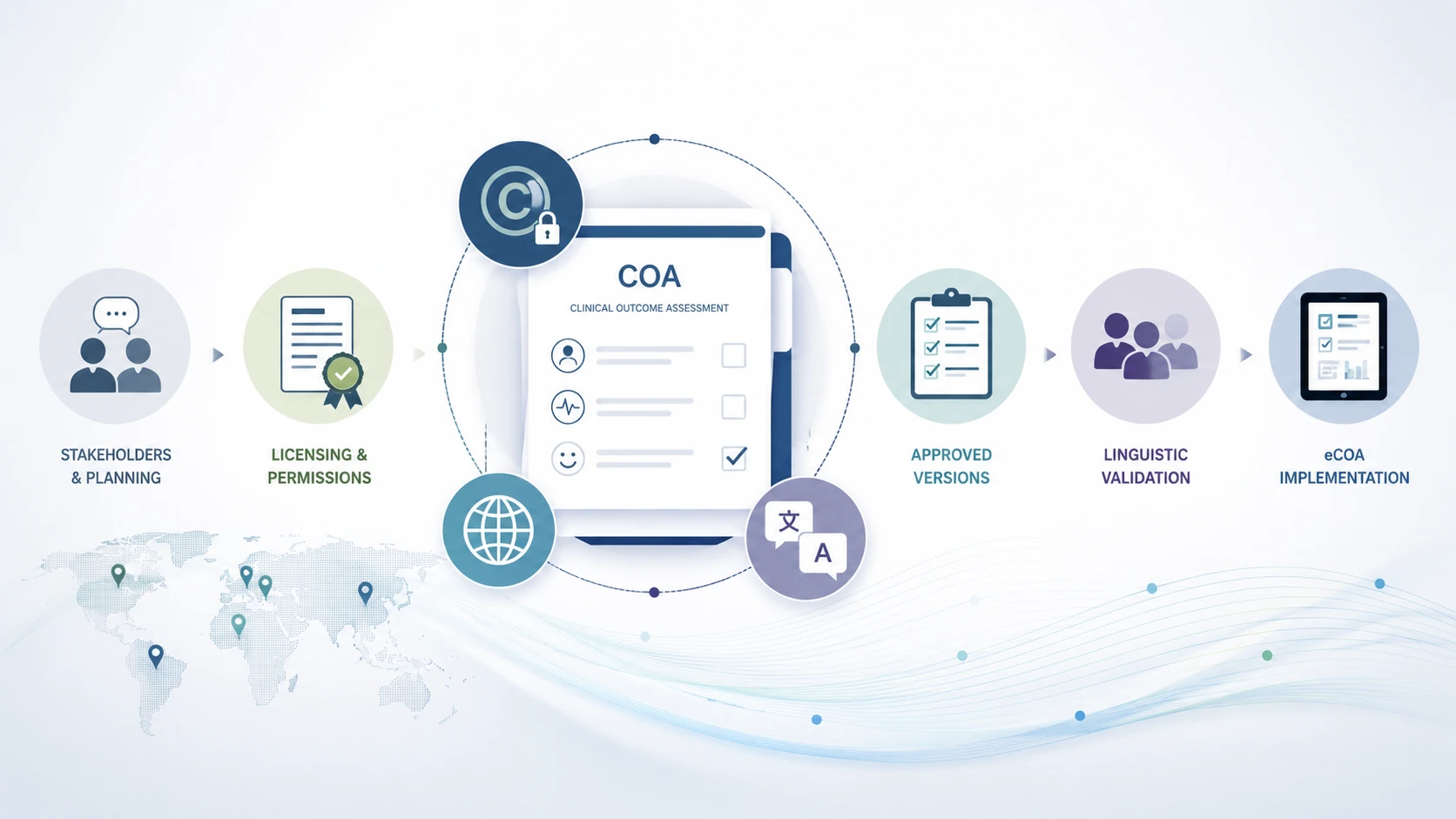
Clients can involve NN Translations for Cognitive Debriefing as an individual project stage or earlier in the COA pathway where coordination across COA licensing, Linguistic Validation and subsequent eCOA implementation is required.
How NN Translations Supports Cognitive Debriefing
NN Translations coordinates Cognitive Debriefing as part of multilingual Linguistic Validation projects, including participant recruitment or patient recruitment, native-speaking Linguistic Validation Consultants, structured interviews, linguistic analysis, translation revisions and coordination with relevant project stakeholders.
Where required, we can also coordinate Clinician Review and clinician recruitment alongside Cognitive Debriefing, allowing the linguistic, clinical and patient perspectives to be managed within one project-specific Linguistic Validation workflow.
Planning Cognitive Debriefing?
Not sure how feasible recruitment will be for your target population? Share the population, countries, languages and expected timeline and we can help assess the recruitment and CD requirements.