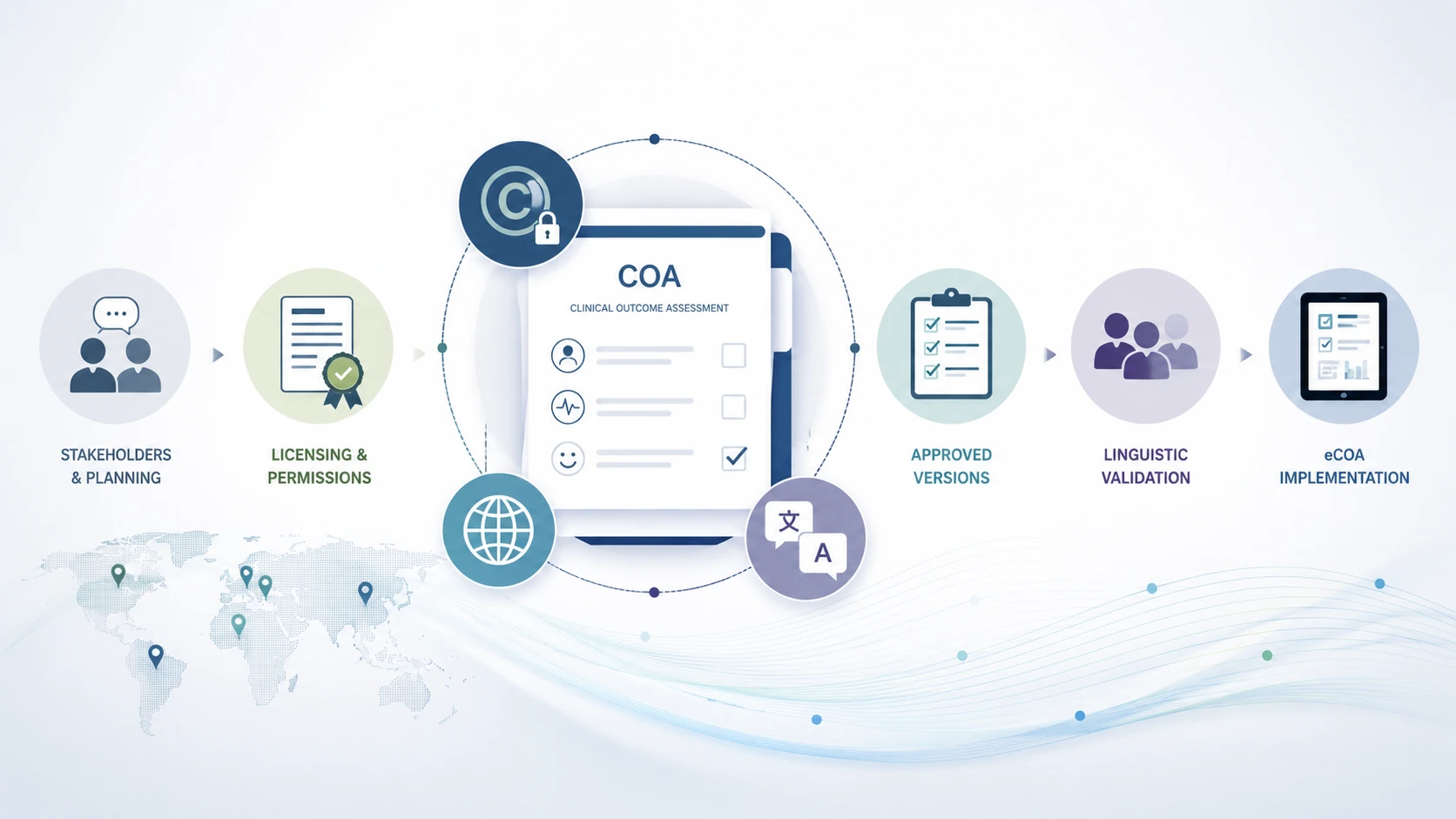
Linguistic Validation (LV) supports the use of Clinical Outcome Assessments (COAs) across different languages, countries and patient populations.
This guide provides a practical introduction to what Linguistic Validation is, why it is important in multinational clinical studies and the stages that may form part of the Linguistic Validation process.
Key takeaways
- Linguistic Validation goes beyond an accurate translation: the aim is a version that is conceptually equivalent, culturally appropriate and clear to the intended population.
- Before translation starts, check whether authorised or validated translations already exist and confirm the exact instrument version and any licensing or copyright-holder requirements.
- The methodology is not always the same – it depends on the instrument, target population, countries, existing translations and developer requirements.
- A full process can include translatability assessment, concept elaboration, forward and back translation, reconciliation, clinician review, cognitive debriefing and final review – not every project needs every stage.
- Planning COA licensing, Linguistic Validation and any later eCOA migration as connected workstreams helps avoid delays and rework.
What Is a COA (Clinical Outcome Assessment)?
A Clinical Outcome Assessment (COA) is a measure used to assess how a patient feels, functions or survives.
COAs provide information about clinical outcomes directly from the patient, from a clinician or observer, or through the patient’s performance of a defined task.
What Are the Different Types of COAs?
There are four main types of Clinical Outcome Assessments:
Patient-Reported Outcomes (PROs)
A Patient-Reported Outcome (PRO) is reported directly by the patient. The questionnaire is completed by the patient regarding their own health condition. PRO measure translation and Linguistic Validation therefore need to preserve the intended concepts and meaning across languages and cultures while ensuring that the content remains appropriate and understandable to patients.
Clinician-Reported Outcomes (ClinROs)
A Clinician-Reported Outcome (ClinRO) is completed by a healthcare professional or clinician based on their clinical observation of the patient.
Observer-Reported Outcomes (ObsROs)
An Observer-Reported Outcome (ObsRO) is completed by a parent, caregiver or other person who observes the patient in daily life. They are particularly useful when patients cannot report for themselves, such as infants or individuals with cognitive impairment.
It is based on aspects of the patient’s health that the observer can see or assess. An ObsRO measure does not include medical judgment or assessment.
Performance Outcomes (PerfOs)
A Performance Outcome (PerfO) measures how a patient performs a specific task, such as walking 10 metres within a specified time or under defined conditions. A clinician or observer may administer the task and record the results, but they do not judge the patient’s performance. For example, the patient may be asked to walk 10 metres, and the time taken to complete the task is recorded.
What Is a COA Instrument?
A COA instrument may include a questionnaire, scale or other measure used to collect clinical outcome data. It can also include supporting information such as instructions for administration, the mode of administration, scoring information and other details.
This distinction becomes important during linguistic validation because the project may involve not only individual questionnaire items but also instructions, response options and other instrument content that needs to remain consistent with the intended use of the COA.
What Is COA Linguistic Validation?
COA Linguistic Validation is the structured process of translating and culturally adapting a Clinical Outcome Assessment for use in another language and/or country while preserving the concepts and intended meaning of the original instrument.
The aim is to produce a version that is:
- conceptually equivalent to the original;
- culturally appropriate for the target country;
- clear and understandable to the intended population;
- expressed using language appropriate for that population and its linguistic context
Linguistic Validation therefore goes beyond producing a linguistically accurate translation.
Why Is Linguistic Validation Important?
In multinational clinical studies, the same COA may be used across different countries and languages.
The language versions need to preserve the same underlying concepts so that the questionnaire continues to measure what it is intended to measure across study populations. At the same time, wording that works in one language or culture may not be clear, natural or appropriate in another.
Linguistic Validation addresses both requirements:
It should preserve the concepts of the original instrument and make the language culturally appropriate and understandable to the target population.
Why Does This Matter for a Clinical Study?
Inadequate Linguistic Validation can create uncertainty about whether patients across countries are interpreting COA content consistently, potentially affecting the comparability of data across languages and populations. Identifying linguistic and cultural issues early can help prevent translation-related issues from emerging later in the study, support consistent COA use across languages and countries, and provide clear documentation of the linguistic validation decisions made throughout the process. If an issue is identified after Linguistic Validation has been completed, affected validation stages or in some cases, the whole Linguistic Validation process may need to be repeated, potentially affecting study timelines and resulting in additional costs.
Why Is Linguistic Validation Different from Standard Translation?
A linguistically correct translation is not necessarily a linguistically validated COA.
Clinical Outcome Assessments may contain concepts, expressions or activities that do not transfer directly between languages and cultures. Differences may relate to:
- everyday language and idiomatic expressions;
- culturally specific activities or references;
- words with more than one possible meaning;
- concepts without a direct equivalent in another language;
- wording that may be interpreted differently by the target population
Linguistic Validation therefore combines translation and cross-cultural adaptation with additional review and, where required, testing with representatives of the intended population.
The objective is not to reproduce every source word literally. It is to preserve the intended concept and meaning while producing language that works for the target population in the country where the instrument will be used.
Conceptual Equivalence in Practice
A literal translation may be linguistically correct while conveying a slightly different concept in the target language. Linguistic Validation evaluates whether the translated wording preserves the concept intended by the source instrument, while remaining natural and understandable to the target population.
Example
For example, a COA may ask how much a patient was “bothered” by a symptom. In another language, a literal translation of “bothered” might be understood as “annoyed,” while the intended concept may be the broader degree to which the symptom troubled or affected the patient. Linguistic Validation considers the intended concept and selects wording that conveys that meaning naturally in the target language rather than simply translating the individual word.
What Should Clients Check Before Starting Linguistic Validation?
Early decisions can affect the Linguistic Validation pathway, scope and timeline of a multilingual COA project. Before translation begins, several points are worth confirming.
Check whether translations already exist
Do not assume that a new translation needs to be created. An authorised or previously validated version may already be available for the required language or country.
Starting a new translation before checking translation availability and validation history can result in unnecessary work and additional costs, or in overlooking an existing authorised or licensed translation that should be used for the study.
Confirm licensing and copyright holder requirements
Where a COA is licensed or copyright protected, confirm who controls the instrument and what requirements apply to translation, adaptation and Linguistic Validation.
The copyright holder may require a particular methodology, use of an existing translation, specific review stages or approval of the final version.
Confirm the exact instrument and version
Instrument names alone may not be sufficient. Different versions can contain different items, instructions, response options or other content.
Confirming the exact COA, version and required materials helps ensure that translation availability, licensing and Linguistic Validation requirements are assessed against the correct instrument.
Do not assume one language version will work in every country
The same language may be used differently across countries. An existing translation may therefore be suitable as it is, require country-specific adaptation, or in some cases not be appropriate for the intended population.
Language and country requirements should be considered together rather than selecting languages alone.
Allow enough time for the complete process
Linguistic Validation can involve several sequential stages as well as developer and/or copyright holder review, clinician recruitment, patient recruitment and Cognitive Debriefing.
Recruitment can require additional time where the target population is narrowly defined or the condition is rare. These dependencies should be considered when establishing the study timeline.
Define the target population early
The intended respondents can influence translation choices, cultural adaptation and Cognitive Debriefing requirements.
Factors such as age, health condition, disease severity and other population characteristics may affect whether particular wording is appropriate and how the translated instrument should be tested.
Consider the intended mode of administration
If the COA will ultimately be implemented electronically, the intended mode should be known early.
Considering COA licensing, Linguistic Validation and subsequent eCOA migration as connected activities can help identify requirements early, reduce unnecessary changes and support consistent implementation of the validated content.
Assess changes before modifying validated content
Once a translation has been validated, changes should not automatically be treated as simple text edits.
The impact of a proposed change should be considered because affected Linguistic Validation stages may need to be repeated, depending on the nature of the modification and applicable methodology, potentially resulting in additional costs and study delays.
Is the Linguistic Validation Process Always the Same?
No. The appropriate methodology depends on the COA and the requirements of the individual project.
Factors may include:
- the instrument and version;
- target population;
- countries and language variants;
- available authorised or validated translations;
- instrument developer and/or copyright holder requirements;
- intended mode of administration;
- study-specific requirements
Some projects require a new translation from the source instrument, while others may use an existing validated language version as the basis for country-specific adaptation.
Depending on the project, the Linguistic Validation process may include:
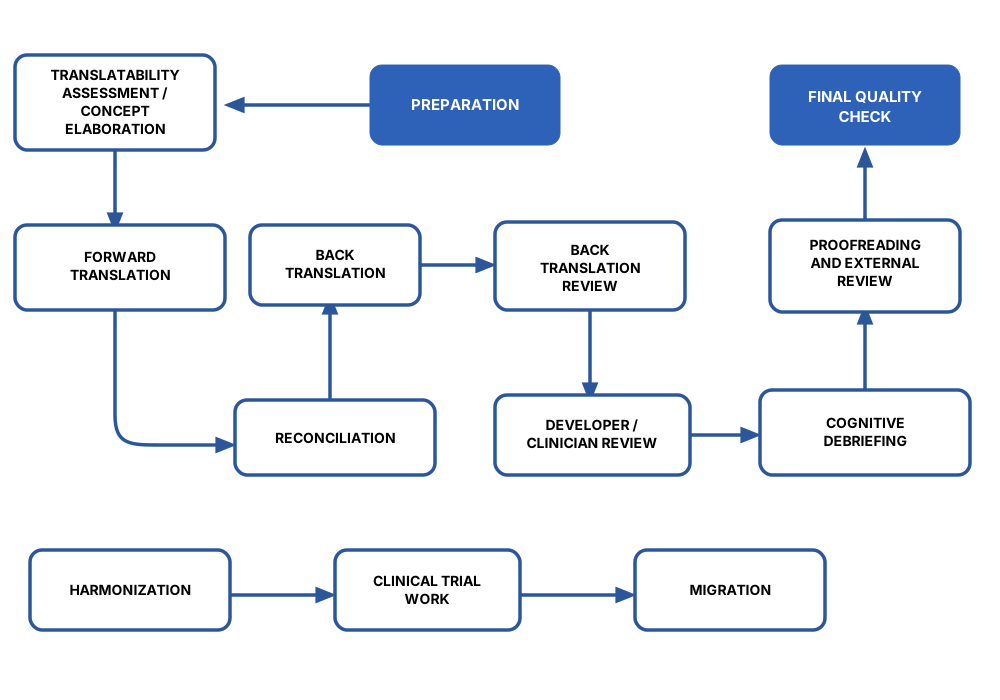
Not every project will require every stage, and the sequence may vary according to the applicable methodology and instrument requirements.
Where licensing applies, the relevant translation, adaptation and Linguistic Validation requirements should be confirmed with the appropriate licensing party and copyright holder.
To learn more about COA Licensing and Management, refer to our COA Licensing and Management Guide.
Where Can Early Linguistic Validation Planning Save Time and Cost?
Linguistic Validation planning can begin before the final project methodology has been defined. Early review can help identify what already exists, what is actually required and where potential gaps or dependencies may affect the project.
This may include:
- checking whether authorised or validated translations already exist;
• identifying whether a new translation or country-specific adaptation may be required;
• reviewing available Linguistic Validation history and identifying validation gaps;
• confirming relevant developer or copyright-holder requirements;
• identifying clinician or patient recruitment requirements early;
• considering the planned mode of administration and subsequent eCOA migration;
• identifying activities that may affect the study timeline before translation begins
Establishing the appropriate pathway early can help avoid unnecessary translation or validation activities, reduce duplication and provide greater visibility of timelines and costs before the project progresses.
What If the Linguistic Validation Methodology Has Not Yet Been Defined?
Clients do not need to have the complete Linguistic Validation pathway established before contacting us.
If the COAs, target population, countries and languages are known, we can review the available information and help identify translation availability, potential validation gaps and the Linguistic Validation activities that may need to be considered.
The applicable requirements of the instrument developer, copyright holder or licensing party should also be confirmed and incorporated into the project planning and Linguistic Validation methodology.
This allows the Linguistic Validation scope to be developed around the actual instrument and study requirements rather than applying a standard workflow automatically.
Understanding the Linguistic Validation Process
Once the appropriate methodology has been established, Linguistic Validation progresses through a series of translation, review, testing and quality control stages.
The following sections explain what each stage does, why it may be required and how it contributes to the final validated version.
01Translatability Assessment
A Translatability Assessment (TA) is performed before translation to identify source content that may create linguistic, conceptual or cultural difficulties across languages.
The assessment may identify:
- ambiguous wording;
- idiomatic expressions;
- terminology without a direct equivalent;
- culturally specific concepts;
- concepts that may not apply in the same way across countries;
- complex grammar or syntax;
- wording with several possible meanings
The objective is to identify potential risks before translation begins, allowing questions or problematic concepts to be considered early and more consistently across languages.
02Concept Elaboration
Concept Elaboration clarifies the intended meaning of the source content and provides a conceptual reference for the Linguistic Validation process.
Rather than prescribing exact translations, it helps translators and reviewers understand what each item is intended to communicate.
Concept Elaboration may include explanations of key concepts, distinctions between related concepts, clarification of ambiguous wording, terminology guidance, acceptable alternatives and relevant cultural or linguistic considerations.
Together, Translatability Assessment identifies where difficulties may arise, while Concept Elaboration helps clarify what needs to be preserved when those concepts are translated.
03Forward Translation
In a standard Linguistic Validation workflow, two independent forward translations are produced by qualified native-speaking linguists.
The translators work independently so that different ways of expressing the same concepts can be considered.
The objective is not a word-for-word translation. Each version should preserve the intended meaning of the source while being natural, clear and culturally appropriate for the target population.
Where an existing validated translation is available for another country or language variant, an adaptation workflow may be used instead of creating a completely new translation from the source.
04Reconciliation
During Reconciliation, the forward translations are compared and combined into a single reconciled version.
The Linguistic Validation Consultant (LVC) evaluates the available translation options against the source text and selects the most appropriate wording for each segment.
The reconciled version should remain conceptually equivalent to the source while being appropriate for the target language and culture.
05Back Translation
The reconciled target language version is then translated back into the source language by an independent linguist.
The purpose of Back Translation is to support the assessment of conceptual equivalence between the translated version and the original instrument.
The back translation is therefore a quality assessment tool rather than a translation intended for patients or other end users.
06Back Translation Review
During Back Translation Review, the back translation is compared with the original source instrument and the reconciled target version to identify potential differences in meaning.
Not every difference indicates a problem. Languages often express the same concept differently.
The review therefore focuses on identifying potential conceptual discrepancies that may require clarification or revision. Any queries and required changes are documented and resolved before the process progresses.
07Developer and Copyright Holder Review
Where required, the translation and supporting documentation may be reviewed by the instrument developer and/or copyright holder.
This review provides an opportunity to confirm that the intended meaning of the source has been preserved and to resolve questions identified during earlier linguistic validation stages.
Where questions or changes arise, these are discussed, agreed changes are incorporated and the resulting decisions are documented.
The exact review process depends on the requirements of the individual instrument, developer and copyright holder.
08Clinician Review
Where appropriate, the translated COA should be reviewed by a qualified clinician who is a native speaker of the target language and has relevant therapeutic area experience.
The clinician provides a clinical perspective on the translation and may assess:
- medical and clinical terminology;
- clinical appropriateness;
- clarity;
- suitability for the intended population;
- terminology commonly used in the target country or clinical setting
Clinician Review is different from linguistic review. The clinician provides specialist clinical input, while the Linguistic Validation Consultant evaluates that feedback alongside the linguistic and conceptual requirements of the instrument.
Clinician selection criteria may include professional qualifications, clinical experience, therapeutic area expertise, country and native language, depending on the project requirements.
09Cognitive Debriefing
Cognitive Debriefing (CD) evaluates whether patients or other intended respondents understand the translated COA as intended.
Eligible patients from the target population are recruited and structured interviews are conducted by native-speaking Linguistic Validation Consultants.
During the interview, patients are asked about their understanding of the translated content. Their feedback can help identify wording that may be unclear, difficult to understand or interpreted differently from the intended source concept.
What Happens to Patient Feedback?
Patient feedback does not automatically lead to a translation change.
The Linguistic Validation Consultant analyses the feedback to determine whether it indicates a genuine comprehension, linguistic or cultural issue and whether a modification may be appropriate.
Where changes are proposed following Cognitive Debriefing, they may be submitted to the developer or other relevant stakeholder for review where required.
The objective remains to improve comprehension without changing the concept measured by the source instrument.
Patient recruitment criteria are determined according to the instrument and study requirements and may include factors such as diagnosis or health condition, age range, gender, education, country and native language.
Explore our Cognitive Debriefing guide →
10External Review, Proofreading and Final Linguistic Review
Once the main Linguistic Validation stages have been completed, an additional independent linguistic review may be performed.
The External Reviewer is a qualified native speaker who has not participated in the previous stages of the project. This provides an independent review of the final translated version.
The final linguistic review and proofreading can assess areas such as:
- linguistic accuracy;
- terminology and consistency;
- grammar and spelling;
- completeness;
- readability;
- overall linguistic quality
Feedback from previous stages is incorporated and the final translation is checked before finalisation.
11Final Quality Check
The final version is checked to confirm that approved changes have been incorporated correctly and that the completed instrument is ready for finalisation.
This stage can include checks of the final content and presentation, including formatting, numbering, completeness and other final document elements.
The exact finalisation process depends on the project and required deliverables.
12Final Documentation and Certification
Linguistic Validation is a documented process.
Project documentation records the stages performed, reviews undertaken, queries raised and translation decisions made throughout the workflow.
At the end of the process, NN Translations provides a final Linguistic Validation report and Certificate of Linguistic Validation documenting completion of the agreed Linguistic Validation process.
What If an Existing Validated Translation Is Available?
A new translation from the source instrument may not always be necessary.
Where an existing validated translation is available for another country or region sharing the same language, an adaptation workflow may be appropriate.
Adaptation starts from the existing validated translation and assesses whether linguistic or cultural changes are needed for the target country while maintaining conceptual equivalence with the source instrument.
Who Is Involved in Linguistic Validation?
Linguistic Validation can involve several specialists and stakeholders depending on the project and required methodology.
These may include the clinical trial sponsor or CRO, COA licensing company or copyright holder, instrument developer, clinical trial professionals, Linguistic Validation Consultant, translators, back translator, independent reviewer, clinicians, target population patients, eCOA providers and others.
Not everyone is involved at every stage. The required roles depend on the instrument and project methodology.
For multilingual studies, coordination is particularly important because the same conceptual and methodological requirements may need to be applied consistently across multiple languages and countries.
Clinician and Patient Recruitment
Clinician and patient recruitment can be an important part of the Linguistic Validation workflow where Clinician Review or Cognitive Debriefing is required.
Recruitment criteria are established according to the instrument and study requirements.
For patients, these may include diagnosis or health condition, age range, gender, education, country, native language and other population-specific characteristics.
For clinicians, criteria may include professional qualifications, clinical experience, therapeutic area expertise, country and native language.
Recruitment may take place through patient organisations, medical centres, healthcare professionals and other appropriate local channels, depending on the target population and project requirements.
What Can NN Translations Coordinate?
Depending on the project scope, NN Translations can coordinate the Linguistic Validation pathway across languages, Linguistic Validation Consultants, translators and reviewers, clinicians, target population patients and other relevant stakeholders.
Support can extend from translation availability and gap assessment through Linguistic Validation, clinician and patient recruitment, Cognitive Debriefing, final linguistic review and documentation.
We can also assist with COA Planning & Consulting, COA Licensing & Management and subsequent eCOA Migration & Support.
Clients can involve NN Translations at an individual project stage or earlier in the COA pathway where coordination across licensing, Linguistic Validation and eCOA implementation is required.
Explore Our Linguistic Validation Services →
How Does Linguistic Validation Connect with eCOA?
Linguistic Validation and electronic implementation are related but as separate processes.
When a validated COA is migrated to an electronic mode of administration, support can continue through activities such as migration review and screenshot review (SSR).
The objective is to support accurate implementation of the validated content and help preserve its conceptual equivalence, content integrity and usability in the electronic environment.
NN Translations also works with eCOA providers while coordinating with the clinical trial sponsor, COA licensing company, copyright holder and other relevant stakeholders.
Explore our eCOA Migration Guide →
Frequently Asked Questions
When should Linguistic Validation start?
Ideally, LV should be considered early in COA and study planning, alongside instrument selection, licensing, language requirements and planned mode of administration
What is the difference between translation and Linguistic Validation?
Translation focuses on transferring content into another language. Linguistic Validation goes further by addressing conceptual equivalence, cultural appropriateness and understanding by the intended population.
Is the Linguistic Validation process the same for every COA?
No. The methodology depends on the instrument, existing translations, target population, languages and countries, mode of administration, study requirements and any requirements specified by the copyright holder or instrument developer.
What if a validated translation already exists?
A new translation may not be necessary. We assess whether the existing version can be used or whether country-specific adaptation or additional Linguistic Validation is required.
Are Cognitive Debriefing and Clinician Review always required?
No. Whether these steps are required depends on the COA, intended respondents, study requirements and applicable Linguistic Validation methodology. Where required, we can coordinate patient and clinician recruitment.
Discuss your Linguistic Validation project
You do not need to have the complete Linguistic Validation methodology defined before contacting us.
Contact us at any stage of your study or COA planning.
Share the information currently available, such as the COA or instrument list, target population, countries and languages, existing translations, planned mode of administration and expected study timeline, and we can help determine the appropriate Linguistic Validation pathway.
We can also assist with COA Planning & Consulting, COA Licensing & Management, and subsequent eCOA Migration & Support, helping connect the different stages of the COA pathway.