linguistic-validation-hero-coa-interview

Services

Linguistic Validation for Global Clinical Trials

NN Translations provides specialist Linguistic Validation (LV) of Clinical Outcome Assessments (COAs) for use across languages, cultures and modes of administration.

Our focus goes beyond linguistic accuracy. We work to preserve the conceptual equivalence, cultural appropriateness and intended meaning of each instrument across target populations, supporting reliable and comparable clinical outcome data in multinational studies.

Our COA translation and Linguistic Validation services support Patient-Reported Outcomes (PROs), Clinician-Reported Outcomes (ClinROs), Observer-Reported Outcomes (ObsROs) and Performance Outcomes (PerfOs) across more than 200 languages.

Our involvement can begin during early study and COA planning and consulting and continue through COA licensing and management coordination, translation availability and Linguistic Validation gap assessment, the full Linguistic Validation process, and subsequent eCOA migration & support.

Our Approach

A Project-Specific Linguistic Validation Approach

There is no single workflow suitable for every COA.

The appropriate linguistic validation methodology depends on the instrument, existing translations, target population, languages and countries, mode of administration, study requirements, including those of medical device clinical trials and clinical investigations, and any methodology specified by the copyright holder or instrument developer.

Before Linguistic Validation begins, we can assess existing translation availability and suitability, previous validation methodology, potential language or country adaptations, and applicable developer or copyright holder requirements.

Where required, we can also coordinate COA licensing with specialist partners before linguistic validation begins.

Workflow

Our Linguistic Validation Workflow

Depending on the instrument, existing translations, target population and project requirements, the Linguistic Validation workflow may include:

NN Translations - Linguistic Validation Steps

We coordinate the required linguistic, clinical and patient-facing stages within a documented project-specific workflow and provide a final Linguistic Validation report and Certificate of Linguistic Validation.

linguistic-validation-clinician-review

Recruitment

Clinician and Patient Recruitment

Recruitment is often one of the most operationally challenging elements of Linguistic Validation.

NN Translations coordinates clinician and patient recruitment across target markets as part of the Linguistic Validation workflow.

Patient recruitment criteria are established according to the instrument and study requirements and may include diagnosis or health condition, age, country, native language and other population-specific characteristics. Clinician criteria may include professional qualifications, clinical experience and relevant therapeutic area expertise.

Recruitment can be coordinated through patient organisations, medical centres, healthcare professionals and other appropriate local channels.

This allows recruitment, interviews, linguistic analysis and resulting translation decisions to remain coordinated within a single linguistic validation process.

eCOA

From Linguistic Validation to eCOA

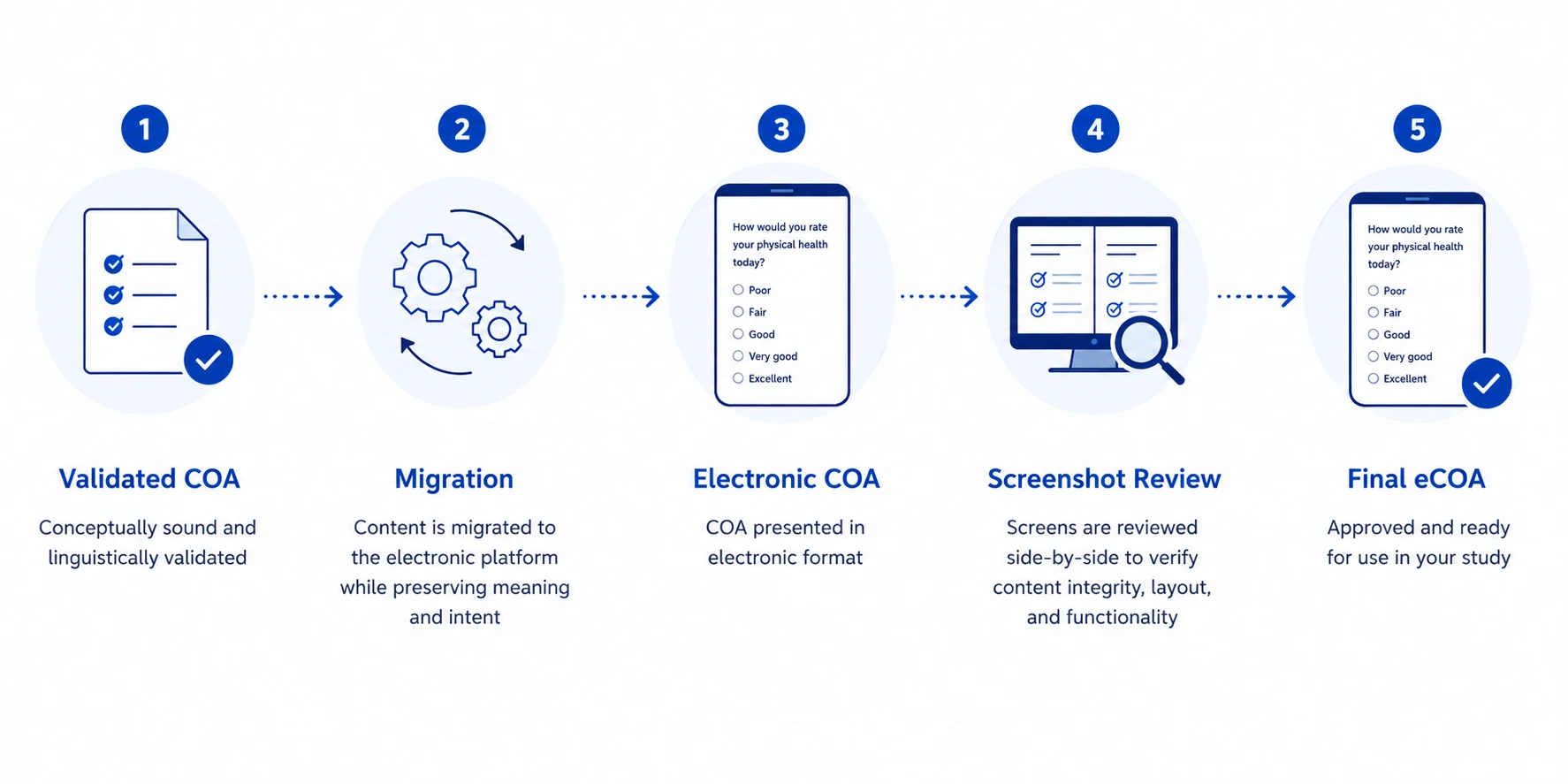
Linguistic Validation does not necessarily end when the translated instrument is approved.

Where validated COAs are migrated to electronic modes of administration, we work with eCOA providers to support migration review and screenshot review (SSR), helping preserve the conceptual equivalence, content integrity and usability of validated COA content when implemented electronically.

linguistic-validation-to-ecoa-migration

Standards

Methodology & Professional Standards

Our Linguistic Validation workflows are informed by recognised industry guidance and good practice, including relevant ISPOR Principles of Good Practice and ISOQOL recommendations, FDA and EMA guidance, together with applicable copyright holder and instrument developer requirements.

Our translation processes are supported by our ISO 17100-certified translation workflow and ISO 9001-certified quality management system.

The final methodology is determined on a project-by-project basis according to the instrument, intended context of use and applicable study and developer requirements.

Why NN Translations

Why Clients Choose Us for Linguistic Validation

Specialist Linguistic Validation Expertise

Linguistic Validation is a core area of our work. Our team combines ISO 17100-certified translation processes and ISO 9001-certified quality management with hands-on experience coordinating complex multilingual Linguistic Validation workflows.

Within one coordinated quality framework, we can manage COA Linguistic Validation alongside the translation of protocols, informed consent forms, patient-facing materials and other clinical trial documentation, supporting linguistic and terminological consistency across the wider study.

One Coordinated Pathway

We can support the pathway from COA planning and consulting through COA licensing and management, translation availability assessment and Linguistic Validation gap assessment, Linguistic Validation and Translation, to subsequent eCOA implementation support, while working alongside clinical trial sponsors, CROs, COA licensing companies, copyright holders and eCOA providers.

Clinician and Participant Access

We coordinate clinicians, patients and other target population participants across markets, allowing specialist review and cognitive debriefing to be integrated directly into the Linguistic Validation workflow.

Resources

Explore Linguistic Validation Resources

Learn more about Linguistic Validation methodology, COA translation and adaptation, cognitive debriefing, clinician review and related topics.

Explore Our Resources

Questions

FAQ

1. When should Linguistic Validation start?

Ideally, LV should be considered early in COA and study planning, alongside instrument selection, licensing, language requirements and planned mode of administration.

2. What is the difference between translation and Linguistic Validation?

Translation focuses on transferring content into another language. Linguistic Validation goes further by addressing conceptual equivalence, cultural appropriateness and understanding by the intended population.

3. Is the Linguistic Validation process the same for every COA?

No. The methodology depends on the instrument, existing translations, target population, languages and countries, mode of administration, study requirements and any requirements specified by the copyright holder or instrument developer.

4. What if a validated translation already exists?

A new translation may not be necessary. We assess whether the existing version can be used or whether country-specific adaptation or additional Linguistic Validation is required.

5. Are Cognitive Debriefing and Clinician Review always required?

No. Whether these steps are required depends on the COA, intended respondents, study requirements and applicable Linguistic Validation methodology. Where required, we can coordinate participant and clinician recruitment.

Discuss Your Linguistic Validation Project

Contact us at any stage of your study or COA planning.

Share the information currently available, such as the COA or instrument list, target population, countries and languages, existing translations, planned mode of administration and expected study timeline, and we can help determine the appropriate Linguistic Validation pathway.